Turkey is one of the rare countries where a traveler can walk through several layers of human history in a single day. In the morning, you might stand inside a Byzantine church that became an Ottoman mosque and later a modern museum or mosque again. By lunch, you may be eating in a neighborhood shaped by centuries of trade, migration and family life. In the afternoon, you can cross from Europe to Asia by ferry while looking at palaces, fortresses and wooden waterfront mansions. This is not just sightseeing. It is a living timeline.
For many visitors, Turkey is first imagined through famous images: the domes of Istanbul, the hot air balloons of Cappadocia, the white terraces of Pamukkale, the ruins of Ephesus and the turquoise coast. But behind these images is a deeper story. Anatolia, the Asian part of Turkey, has been home to some of the world’s earliest settlements, Bronze Age kingdoms, Greek city-states, Roman cities, Byzantine churches, Seljuk caravan routes, Ottoman capitals and modern republican reforms. Every region adds a different chapter.
This guide is written for travelers who want to understand Turkish culture and history before planning a trip. It explains why Turkey became such an important cultural crossroads, how ancient civilizations shaped the land, what the Byzantine and Ottoman periods left behind, and how traditions such as hospitality, tea, coffee, cuisine, markets, baths and family gatherings still shape daily life today. It also helps you connect history with real places you can visit on a Turkey itinerary.
If you are building a route with Azrato or planning a custom journey on Travmetto, use this guide as cultural background. Turkey becomes much more meaningful when you know why Istanbul matters, why Ephesus feels so grand, why Cappadocia’s cave churches are special, why Bursa is central to Ottoman history, and why small daily rituals such as offering tea can tell you as much about the country as a monument.
Why Turkey is one of the world’s great cultural crossroads
Turkey’s cultural identity is shaped by geography. The country sits between Europe, Asia and the Middle East, surrounded by the Black Sea, the Aegean, the Mediterranean and important land routes. For thousands of years, people, armies, merchants, pilgrims, architects, artists and ideas moved through this region. They did not simply pass through; they built cities, temples, ports, roads, fortresses, churches, mosques, bazaars, villages and empires.
This crossroads position explains why Turkey does not fit into one simple category. It is European and Asian, Mediterranean and Middle Eastern, ancient and modern, urban and rural, secular in its state structure and deeply traditional in many social habits. Istanbul alone shows this mixture clearly. Roman aqueducts, Byzantine walls, Ottoman mosques, European-style avenues, modern business districts and ferry culture all exist in the same city.
The same layered feeling appears across the country. In western Turkey, ancient Greek and Roman ruins stand near modern farming towns and coastal resorts. In central Anatolia, Cappadocia’s volcanic valleys contain underground cities, cave churches and villages that feel unlike anywhere else. In southeastern Turkey, sites such as Göbekli Tepe and Mardin connect visitors to very old human history and rich multicultural traditions. In the Black Sea region, mountain villages and tea fields create a completely different cultural landscape.
For travelers, this means Turkey is not a destination to understand through one city only. Istanbul is essential, but it is only one chapter. Ephesus tells the story of ancient urban life. Cappadocia tells the story of geology, early Christianity and village adaptation. Bursa tells the story of early Ottoman power. Konya tells the story of Seljuk culture and Sufi heritage. Antalya and the Lycian coast tell stories of trade, seafaring and ancient cities by the sea.
The earliest civilizations of Anatolia
Anatolia has been inhabited since prehistoric times, and some of the world’s most important early human settlements are located within modern Turkey. Long before classical temples, Roman theaters or Ottoman mosques, communities were building houses, ritual spaces and early forms of social organization here. This gives Turkey a historical depth that surprises many first-time visitors.
One of the most famous prehistoric sites is Göbekli Tepe, near Şanlıurfa. Its monumental stone pillars changed the way many people think about early human society because it suggests complex ritual activity at an extremely early date. Nearby regions of southeastern Turkey are full of archaeological importance, connecting the visitor to the beginnings of settled life, agriculture and symbolic culture.
Another important early settlement is Çatalhöyük, near Konya. It represents a dense Neolithic community where houses were built close together and people moved across rooftops. The site gives clues about domestic life, belief systems, art and social organization. For a traveler, Çatalhöyük is not as visually dramatic as a marble Roman city, but its importance is enormous. It shows how far back the story of Anatolia goes.
These early sites remind us that Turkish history did not begin with the Ottomans, the Byzantines, the Romans or even the Greeks. The land itself carries a much older memory. When you travel across Turkey, you are moving through a place where human communities experimented with settlement, belief, farming, craft and social life for thousands of years.
Hittites and Bronze Age Anatolia
One of the great Bronze Age powers of Anatolia was the Hittite civilization. The Hittites ruled from central Anatolia and built a kingdom that interacted with other major powers of the ancient world. Their capital, Hattusa, near modern Boğazkale, is one of the most important archaeological sites in Turkey. Its city walls, gates, temples and rock sanctuary give a powerful sense of a sophisticated ancient state.
Hattusa is especially valuable for travelers who want to go beyond the usual Istanbul-Cappadocia-Ephesus route. It shows a different side of Turkey: not coastal, not Ottoman, not classical Greek, but Bronze Age Anatolian. The Lion Gate, the King’s Gate and the nearby sanctuary of Yazılıkaya help visitors imagine a world of kings, rituals, gods, diplomacy and fortified cities.
The Hittites also show how Anatolia was connected to wider ancient politics. They negotiated, fought and traded with neighboring powers. Their written records, legal traditions and diplomatic activity place them among the major civilizations of the ancient Near East. Including Hattusa in a cultural itinerary adds real depth for travelers who are interested in archaeology and early empires.
Ancient Greek cities of western Turkey
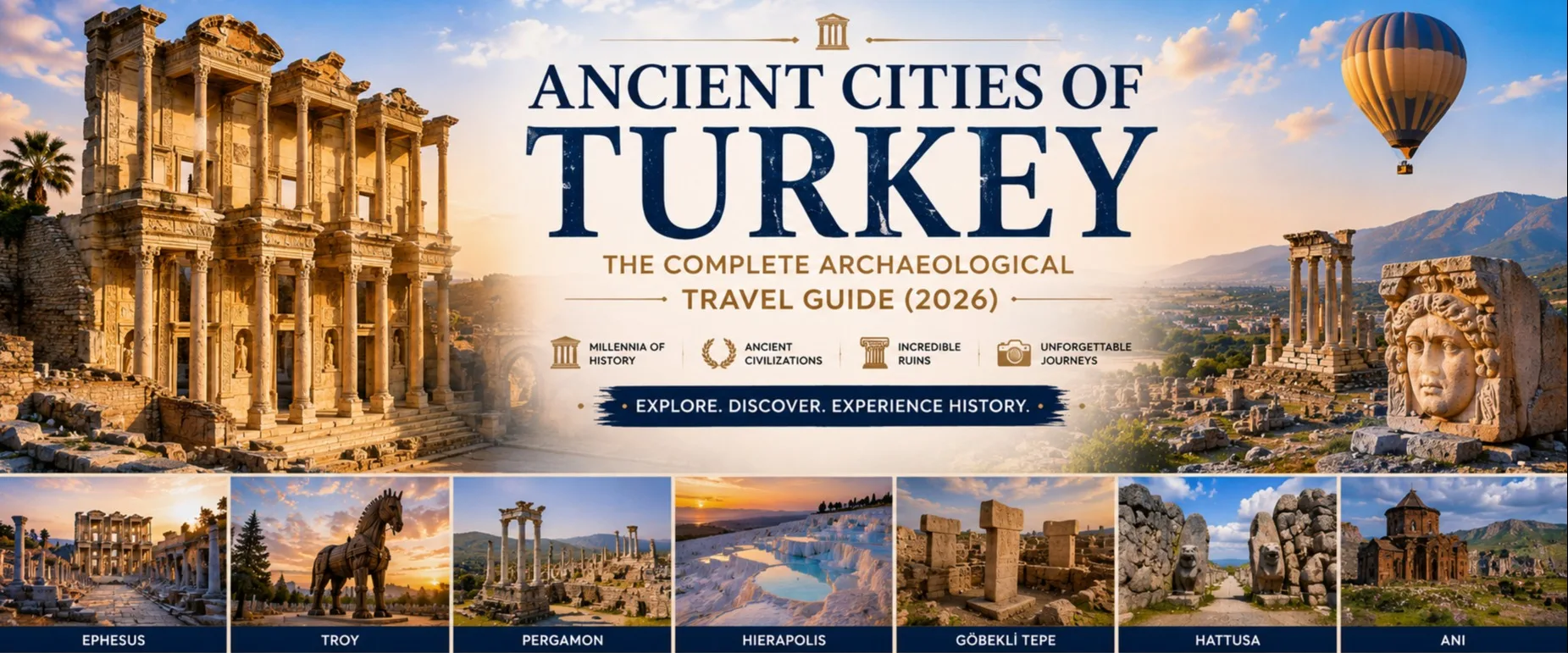
Many visitors are surprised to learn that some of the most impressive ancient Greek and Greco-Roman cities are in modern Turkey. The Aegean coast of Anatolia was home to important city-states, ports, sanctuaries and intellectual centers. Places such as Ephesus, Pergamon, Miletus, Priene, Didyma and Aphrodisias are essential for understanding the ancient Mediterranean world.
Ephesus is the most famous of these sites, and for good reason. Walking along its marble streets, you can see the Library of Celsus, the great theater, terrace houses, temples, baths and public spaces. It gives a strong sense of urban life in antiquity: politics, religion, commerce, entertainment, wealth and daily routines. Ephesus is not just a ruin; it is a city plan you can still read with your feet.
Pergamon, near modern Bergama, offers a different kind of experience. Its acropolis rises dramatically above the surrounding plain, with remains of temples, a steep theater and ancient civic structures. It was once an important cultural and political center. Aphrodisias, inland from the Aegean, is known for sculpture, a beautiful stadium and a strong sense of artistic identity. Priene and Miletus show city planning and coastal trade in ways that reward slower exploration.
These ancient cities are important because they show that western Turkey was deeply connected to the Greek-speaking world while also developing its own local character. They were places of learning, religion, commerce and art. A traveler who visits only Istanbul misses this classical Aegean layer, which is one of Turkey’s greatest cultural treasures.
The Roman legacy in Turkey
Roman influence transformed many cities across Anatolia. Roads, theaters, baths, aqueducts, temples, forums and administrative systems connected the region to a vast empire. In many places, the ruins that visitors see today are not purely Greek but Greco-Roman, showing how earlier cities were expanded and reshaped under Roman rule.
Turkey has some of the best-preserved Roman theaters and urban remains in the eastern Mediterranean. Aspendos, near Antalya, is famous for its remarkably preserved theater. Side combines Roman ruins with a seaside town atmosphere. Perge, also near Antalya, offers colonnaded streets, baths, gates and a stadium. Hierapolis, above the white terraces of Pamukkale, combines thermal culture, necropolis areas and Roman urban remains.
The Roman layer is also visible in Istanbul, which was founded as Byzantium and later refounded as Constantinople. The city’s ancient hippodrome, aqueducts, cisterns and walls connect modern visitors to Roman imperial ambition. The Basilica Cistern is one of the most atmospheric reminders of this era, showing the engineering systems that supported a great capital.
For travelers, Roman Turkey is best understood by combining places. Ephesus shows urban grandeur. Aspendos shows performance and engineering. Perge shows civic planning. Hierapolis shows thermal culture and burial landscapes. Istanbul shows imperial transformation. Together, they reveal how Anatolia became one of the most important regions of the Roman world.
Constantinople and the Byzantine Empire
When Constantine made Constantinople a new imperial capital, the city became one of the most important centers in world history. For more than a thousand years, Constantinople shaped politics, religion, art, architecture and trade between Europe and Asia. Today, Istanbul still carries this Byzantine inheritance, even when it is partly hidden behind later Ottoman and modern layers.
The greatest Byzantine monument is Hagia Sophia. Built as an imperial church, it amazed visitors with its dome, scale and light. It became a symbol of Byzantine power and Christian worship, later became an Ottoman mosque, then a museum, and today functions again as a mosque. This layered identity makes Hagia Sophia one of the most meaningful buildings in the world. It is not only beautiful; it tells the story of empire, conquest, adaptation and memory.
Other Byzantine sites in Istanbul include the city walls, Chora, the Basilica Cistern, the remains of the Great Palace area, churches, cisterns and fragments scattered through old neighborhoods. The Theodosian Walls remind visitors that Constantinople was one of the most heavily defended cities of the medieval world. Chora is especially important for its mosaics and frescoes, offering a more intimate view of Byzantine art.
Cappadocia also has a strong Byzantine and early Christian story. Cave churches in the valleys around Göreme preserve painted interiors and monastic spaces. Underground cities such as Derinkuyu and Kaymaklı show how communities adapted to threat, climate and geology. This is a very different kind of Byzantine heritage from Istanbul’s imperial monuments, but it is just as memorable.
The arrival of the Turks and the Seljuk period
The arrival of Turkic peoples in Anatolia gradually changed the region’s language, politics, architecture and culture. The Seljuk period is an essential bridge between the Byzantine world and the Ottoman world. It introduced new forms of Islamic architecture, caravan trade, madrasas, mosques, tombs and decorative stonework across Anatolia.
Konya is the most important Seljuk city for many travelers. It was the capital of the Seljuk Sultanate of Rum and later became closely associated with Mevlana Jalaluddin Rumi, the great poet and mystic. The Mevlana Museum is one of Turkey’s most visited spiritual sites. It gives visitors a sense of Sufi heritage, poetry, music and devotion.
Seljuk architecture can also be seen in caravanserais across central Anatolia. These roadside inns supported trade routes and protected travelers, merchants and animals. They are reminders that Anatolia was not only a battleground between empires but also a land of commerce, movement and hospitality. Some caravanserais are still visited today on routes between Cappadocia, Konya and Antalya.
The Seljuk period matters because it shaped the cultural landscape that the Ottomans later inherited and expanded. It added Turkish language, Islamic institutions, new artistic forms and trade networks to Anatolia’s already complex history. For a culturally rich itinerary, Konya and Seljuk sites add depth beyond the more familiar Ottoman story.
The rise of the Ottoman Empire
The Ottoman Empire began as a small frontier principality and grew into one of the most powerful empires in world history. Its early capitals and symbolic cities are important for travelers who want to understand how Ottoman culture developed. Bursa and Edirne are especially meaningful before the story reaches Istanbul.
Bursa was the first major Ottoman capital and remains one of the best places to feel early Ottoman atmosphere. The city is known for mosques, tombs, bazaars, silk trade, thermal baths and mountain scenery. The Grand Mosque, Green Mosque, Green Tomb and Koza Han are central to understanding Bursa’s role. The city feels different from Istanbul: calmer, more intimate, and strongly connected to early Ottoman identity.
Edirne was another Ottoman capital before the conquest of Constantinople. The Selimiye Mosque, designed by the great architect Mimar Sinan, is one of the masterpieces of Ottoman architecture. Edirne also reflects the empire’s Balkan connections, with bridges, mosques, markets and culinary traditions. It is a rewarding trip for travelers interested in Ottoman history beyond Istanbul.
The conquest of Constantinople in 1453 transformed the Ottoman state into an imperial power with a world capital. Istanbul became the center of administration, architecture, trade, religion and court culture. Ottoman sultans reshaped the city with mosques, palaces, schools, fountains, baths, bazaars and neighborhoods. The result is the Istanbul many travelers dream of seeing today.
Ottoman Istanbul: palaces, mosques and bazaars
Ottoman Istanbul is best experienced through a combination of monumental and everyday spaces. Topkapı Palace shows the world of the sultans: courtyards, treasury rooms, kitchens, ceremonial gates, views over the Bosphorus and the complex life of the imperial court. It is not a European palace in the same style as Versailles; it is a series of courtyards and pavilions that reflect Ottoman ideas of power, privacy and ceremony.
The great imperial mosques shape Istanbul’s skyline. The Süleymaniye Mosque, built for Sultan Süleyman the Magnificent by Mimar Sinan, is one of the most elegant places in the city. The Blue Mosque, with its domes and minarets, remains one of the most photographed monuments in Turkey. Smaller mosque complexes, fountains and tombs throughout the city show how architecture, charity, worship and public life were connected.
The Grand Bazaar and Spice Bazaar represent another side of Ottoman culture: trade, craft and urban rhythm. These markets were not simply tourist shopping centers; they were part of a commercial system that connected artisans, merchants and consumers. Even today, walking through them gives a sense of continuity, though modern tourism has changed many details.
Ottoman culture was also built around neighborhoods. Wooden houses, local mosques, fountains, bakeries, bathhouses and small markets shaped daily life. Some of this older neighborhood texture can still be felt in areas such as Üsküdar, Eyüp, Fatih, Balat and parts of the Bosphorus. To understand Ottoman Istanbul, do not only visit the famous buildings. Walk slowly through streets where daily life continues around them.
Daily life in the Ottoman era
Daily life in the Ottoman world varied greatly by class, religion, city and region. Istanbul court culture was very different from village life in Anatolia, and a merchant family in Izmir did not live like a farmer in central Anatolia. Still, certain institutions and habits shaped many communities: markets, mosques, churches, synagogues, bathhouses, workshops, coffeehouses, family networks and neighborhood relationships.
The hammam, or Turkish bath, was an important social institution. It was used for cleanliness, relaxation, ceremonies and community life. Historic hammams still exist in many cities, and some have been restored for visitors. Experiencing a hammam today can be tourist-oriented, but it still connects to a long tradition of bathing culture that combines architecture, ritual and social life.
Coffeehouses became important social spaces in the Ottoman world. Men gathered to drink coffee, talk, play games, listen to stories and exchange news. Turkish coffee developed not only as a drink but as a cultural ritual, connected to hospitality, conversation and even fortune-telling. Today, Turkish coffee remains a symbol of tradition, often served after meals or during visits.
Food culture also reflected empire. Ingredients, recipes and techniques moved through palace kitchens, regional households, trade routes and local markets. Ottoman cuisine influenced and was influenced by Balkan, Middle Eastern, Caucasian, Mediterranean and Central Asian traditions. This is one reason Turkish food feels familiar to many cultures but still has its own distinct identity.
Atatürk and modern Turkey
The modern Republic of Turkey was founded in 1923 under the leadership of Mustafa Kemal Atatürk. This marked a major transformation from empire to nation-state. The republican period introduced reforms in law, education, language, dress, administration and public life. Understanding modern Turkey requires understanding this shift, because it still shapes national identity, politics, symbols and daily culture.
Atatürk is one of the most important figures in modern Turkish history. His image is visible in schools, public buildings, offices and homes. For visitors, this can be striking, but it reflects his central role in the creation of the republic. Ankara, the capital, is the best place to understand the republican story. Anıtkabir, Atatürk’s mausoleum, is a major national site and one of the most meaningful places in modern Turkey.
The move of the capital from Istanbul to Ankara was symbolic. Istanbul represented imperial history and cosmopolitan tradition, while Ankara represented a new political center in Anatolia. Modern Turkey did not erase the past, but it reinterpreted it. The country today carries Ottoman, Islamic, Anatolian, Mediterranean, European and republican elements all at once.
For travelers, modern Turkey appears in everyday contrasts. You may see historic mosques beside modern cafés, conservative family traditions beside global fashion, ancient ruins near resort hotels, and local markets near high-speed trains. This combination is not a contradiction; it is part of the country’s identity.
Turkish traditions that still shape daily life
Turkish culture is not only in museums and monuments. It is in daily gestures: offering tea, welcoming guests, sharing food, respecting elders, gathering with family, bargaining in markets, celebrating weddings and marking religious holidays. Travelers who pay attention to these habits often leave with a warmer understanding of the country.
Hospitality is one of the most important cultural values. Guests are treated with care, and offering something to drink is common. Tea may appear during shopping, at a hotel reception, in an office, after a meal or during a village visit. Accepting tea is not required, but it is often a friendly way to join the rhythm of conversation.
Family also plays a central role. Many social decisions, celebrations and daily routines are connected to family networks. Meals are often shared, children are welcomed in many public spaces, and respect for older relatives remains important. Travelers with children often notice that Turkish people can be especially warm toward families.
Markets are another living tradition. Weekly neighborhood markets sell fruits, vegetables, cheese, olives, textiles and household goods. Covered bazaars and local markets show how commerce remains social as well as practical. Even in modern cities, market culture keeps a strong place in daily life.
Turkish tea and coffee culture
Tea is everywhere in Turkey. Served in small tulip-shaped glasses, Turkish tea is part of work, friendship, shopping, family visits and rest stops. It is not only a beverage but a social signal. A conversation often begins or continues over tea. In the Black Sea region, where much of Turkey’s tea is grown, tea culture is connected to landscape, agriculture and regional identity.
Turkish coffee has a different rhythm. It is thicker, stronger and usually served in small cups with grounds at the bottom. It is associated with hospitality, ceremony and conversation. Traditionally, coffee also plays a role in engagement customs, where the bride-to-be may serve coffee during family visits. Fortune-telling from coffee grounds is a playful tradition many visitors enjoy hearing about.
For travelers, the best way to experience tea and coffee culture is not only in famous cafés. Drink tea on a ferry, in a small shop, at a roadside stop, in a village guesthouse or after dinner. Try Turkish coffee in a historic café, but also in a modern neighborhood. The ritual matters as much as the taste.
Turkish cuisine as cultural history
Turkish cuisine is one of the clearest ways to experience the country’s history. It reflects nomadic Central Asian roots, Anatolian agriculture, Ottoman palace refinement, Mediterranean olive oil culture, Black Sea ingredients, southeastern spices, Balkan influences and local village cooking. There is no single Turkish food experience; every region adds something different.
Istanbul is the best place to see variety. You can try street foods such as simit, fish sandwiches, roasted chestnuts and stuffed mussels, then move to meyhane culture, Ottoman-style dishes, modern Turkish restaurants and neighborhood bakeries. The city’s food culture reflects its role as an imperial and migrant center.
The Aegean coast is known for olive oil dishes, herbs, seafood, vegetables and a lighter Mediterranean style. Southeastern Turkey is famous for kebabs, baklava, pistachios, spices and rich breakfast traditions. The Black Sea region brings corn, anchovies, tea, butter and mountain flavors. Central Anatolia offers hearty dishes shaped by wheat, meat, yogurt and long winters.
Food is also connected to hospitality. A meal is often an act of care, not just consumption. Guests may be encouraged to eat more, taste everything and sit longer. For visitors, joining a food tour, market walk or home-style meal can reveal more about Turkish culture than a standard restaurant checklist.
Religion and cultural life in Turkey
Turkey is a secular republic with a majority Muslim population, and religion remains visible in daily life, architecture, holidays and social customs. Mosques are central landmarks in cities and villages. The call to prayer is part of the soundscape. Religious holidays such as Ramadan Bayram and Kurban Bayramı are important family and community occasions.
Visitors are welcome in many mosques outside prayer times, but respectful behavior matters. Dress modestly, remove shoes, speak quietly and follow local guidance. Women usually cover their hair when entering active mosques. In major tourist mosques, scarves and visitor instructions are often available.
Turkey also has a long history of religious diversity. Christianity, Judaism, Islam and many local traditions have shaped the region. Byzantine churches, Armenian churches, Greek Orthodox heritage, synagogues, Sufi lodges and Islamic complexes all form part of the cultural landscape. Some communities are smaller today than they once were, but their historical presence remains important.
For travelers, religious heritage should be approached with curiosity and respect. A mosque, church or tomb is not only an architectural object; it may be a living place of devotion. The most rewarding visits are those that balance photography with awareness.
UNESCO World Heritage and cultural highlights
Turkey has many sites recognized for their cultural or natural importance. These places help travelers structure a historically rich itinerary. Istanbul’s historic areas, Cappadocia and Göreme, Ephesus, Pamukkale-Hierapolis, Hattusa, Troy, Pergamon, Aphrodisias, Bursa and Cumalıkızık, Safranbolu, Diyarbakır Fortress and Hevsel Gardens, Göbekli Tepe and others all represent different chapters of the country’s story.
UNESCO sites are useful because they show diversity. Istanbul represents imperial layers. Cappadocia combines geology and early Christian heritage. Ephesus represents ancient urban life. Pamukkale-Hierapolis combines natural terraces and Roman thermal culture. Hattusa represents Bronze Age power. Troy connects archaeology with legendary imagination. Safranbolu preserves Ottoman urban architecture.
A traveler does not need to visit every UNESCO site to understand Turkey. Instead, choose a balanced route. For a first trip, Istanbul, Cappadocia, Ephesus and Pamukkale create an excellent historical foundation. For a deeper cultural route, add Bursa, Konya, Troy, Safranbolu or southeastern Turkey. For archaeology lovers, Aphrodisias, Pergamon, Priene, Miletus, Hattusa and Göbekli Tepe deserve serious attention.
Famous historical places every visitor should consider
Istanbul is essential for Hagia Sophia, Topkapı Palace, the Blue Mosque, Süleymaniye Mosque, the Grand Bazaar, the Basilica Cistern, Galata, the Bosphorus and historic neighborhoods. It is the best place to understand Byzantine, Ottoman and modern layers together.
Cappadocia is essential for cave churches, underground cities, valleys, village life and surreal landscapes. It is both cultural and natural, and it becomes more meaningful when you understand its early Christian and local settlement history.
Ephesus is the best ancient city for first-time visitors. It is visually impressive, easy to understand and close to other meaningful places such as the House of Virgin Mary, the Temple of Artemis area, Selçuk and Şirince.
Pamukkale and Hierapolis combine natural beauty with ancient history. The white terraces attract attention first, but the ancient city above them gives the visit deeper meaning.
Bursa is essential for early Ottoman history, silk trade, mosques, tombs, bazaars and food. It is one of the best additions for travelers who want culture beyond the most common route.
Konya is important for Seljuk heritage and Mevlana. It offers a spiritual and historical perspective that is very different from coastal Turkey or Istanbul.
Troy and Çanakkale connect archaeology, legend and modern history. Combined with Gallipoli, the region becomes one of the most powerful historical landscapes in western Turkey.
Cultural etiquette for travelers
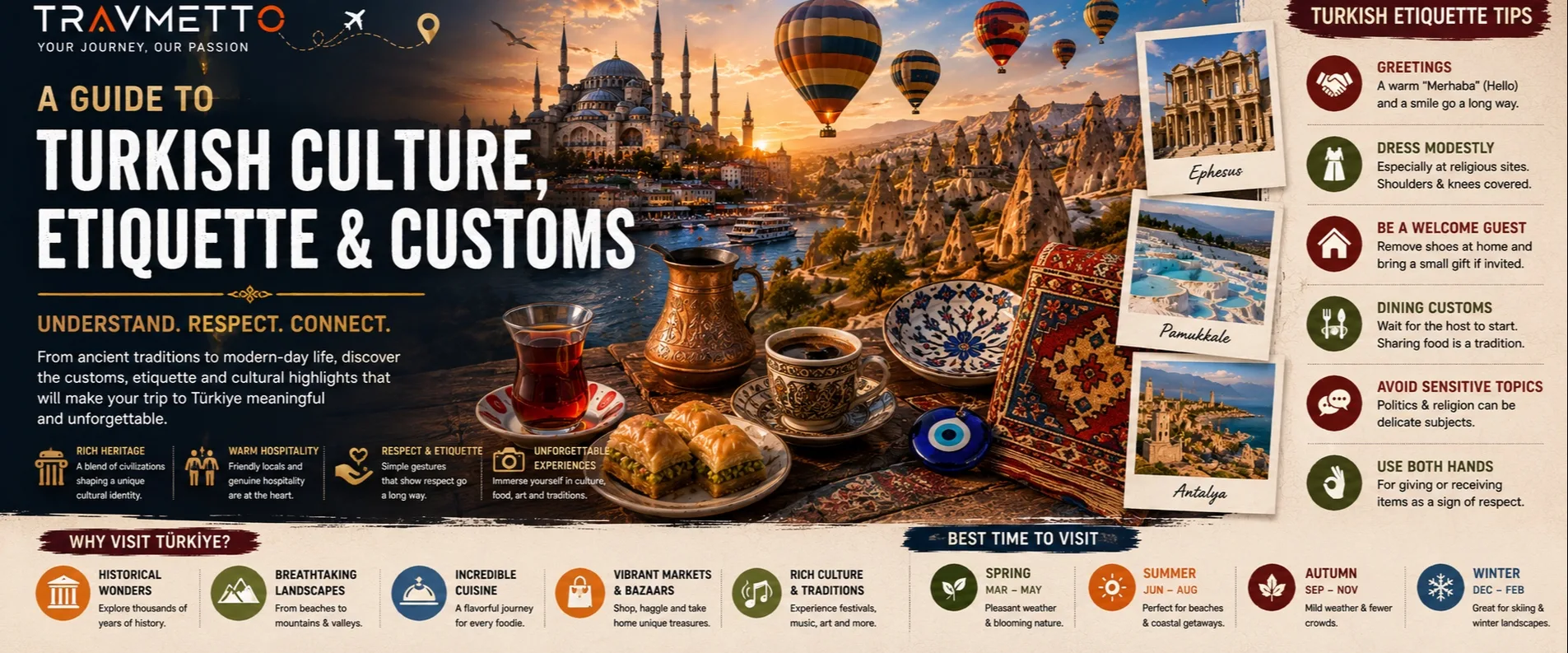
Turkish people are generally warm toward visitors, but cultural sensitivity makes travel smoother. Basic politeness matters. Learning simple words such as “merhaba” for hello, “teşekkürler” for thank you and “lütfen” for please is appreciated. A friendly greeting can change the tone of a shop visit, hotel conversation or restaurant interaction.
When visiting mosques, dress respectfully and follow instructions. Avoid loud conversation during prayer times. Do not walk in front of people praying. Photography may be allowed in many places, but avoid photographing worshippers closely without permission.
In markets, bargaining may be normal in tourist bazaars and some shops, but not in supermarkets, restaurants or modern stores with fixed prices. Bargain with humor and respect, not aggression. If you accept tea in a shop, it does not always mean you must buy something, but be polite with the time you take.
When invited into a home, removing shoes is common. Bringing a small gift, dessert or flowers can be thoughtful. Complimenting food is appreciated. Turkish hosts may insist that you eat more; this is usually generosity rather than pressure.
Festivals and celebrations in Turkey
Turkish cultural life includes national holidays, religious holidays, local festivals, music events, food festivals and seasonal celebrations. Republic Day on October 29 is one of the most important national holidays, marked with flags, ceremonies and public pride. April 23, National Sovereignty and Children’s Day, is also deeply meaningful and child-focused.
Religious holidays follow the Islamic lunar calendar, so their dates change each year. Ramadan is a month of fasting for many people, followed by Ramadan Bayram. Kurban Bayramı is another major holiday, connected to family visits, charity and sacrifice traditions. For travelers, these periods can be culturally rich but also affect opening hours, domestic travel demand and hotel prices.
Local festivals vary by region. There are oil wrestling festivals, cherry festivals, grape harvest events, music festivals, film festivals, jazz festivals, religious commemorations, art events and village celebrations. The Aegean and Mediterranean coasts are especially active in summer, while Istanbul has cultural events throughout the year.
Before traveling, it is useful to check whether your dates overlap with major holidays. This can be positive if you want atmosphere, but it may also mean crowded roads, higher domestic flight demand and busier hotels. Planning ahead is especially important around Bayram holidays.
How to build a culture and history itinerary in Turkey
A strong culture and history itinerary should balance famous highlights with slower local experiences. Do not fill every hour with monuments. Leave time for tea breaks, markets, ferries, neighborhood walks and regional meals. These softer experiences often become the most memorable parts of the trip.
For a first-time cultural route of seven to ten days, combine Istanbul, Cappadocia, Pamukkale and Ephesus. This gives you Byzantine and Ottoman history, cave churches and valleys, Roman thermal culture and one of the greatest ancient cities in the Mediterranean. If you have more time, add Bursa, Konya, Troy, Pergamon or Antalya’s ancient sites.
For an Ottoman-focused route, spend more time in Istanbul, Bursa and Edirne. For an archaeology-focused route, combine Istanbul with Troy, Pergamon, Ephesus, Aphrodisias, Pamukkale-Hierapolis, Perge, Aspendos and Side. For a spiritual and cultural route, include Istanbul, Konya, Cappadocia, Şanlıurfa and Mardin.
The key is not to chase every famous place. Turkey is large, and travel time matters. Choose a theme, then build a route that respects geography. A well-paced route with five meaningful places is better than a rushed route with ten exhausted stops.
Frequently asked questions about Turkish culture and history
What is Turkish culture known for?
Turkish culture is known for hospitality, tea and coffee traditions, rich cuisine, family life, historic architecture, bazaars, music, hammam culture and a unique mix of Anatolian, Mediterranean, Ottoman, Islamic and modern influences.
How old is Turkish history?
The history of the land now called Turkey goes back thousands of years, including prehistoric settlements, Bronze Age civilizations, ancient Greek cities, Roman and Byzantine periods, Seljuk rule, the Ottoman Empire and the modern Republic of Turkey.
What are the most important historical sites in Turkey?
Some of the most important sites include Istanbul’s historic areas, Ephesus, Cappadocia, Pamukkale-Hierapolis, Troy, Pergamon, Hattusa, Göbekli Tepe, Bursa, Konya and Aphrodisias.
Is Turkey culturally European or Asian?
Turkey is both European and Asian geographically and culturally. Its identity includes European, Asian, Middle Eastern, Mediterranean, Balkan, Caucasian and Anatolian influences.
What is the Ottoman Empire?
The Ottoman Empire was a major empire that began in Anatolia and expanded across southeastern Europe, the Middle East and North Africa. Its capital was Istanbul after the conquest of Constantinople in 1453.
Why is Istanbul historically important?
Istanbul was once Constantinople, capital of the Byzantine Empire, and later became the capital of the Ottoman Empire. Its location on the Bosphorus made it one of the world’s most important political, religious and trade centers.
How can travelers experience authentic Turkish culture?
Travelers can experience authentic culture by visiting local markets, taking ferries, trying regional food, drinking tea with locals, exploring neighborhoods beyond main tourist streets, visiting mosques respectfully and including smaller towns in their itinerary.
Final thoughts: Turkey is best understood in layers
Turkey is not a destination with one story. It is a country of layers. Prehistoric communities, Hittite kings, Greek cities, Roman engineers, Byzantine emperors, Seljuk builders, Ottoman sultans, Sufi poets, republican reformers, village families, urban artists and modern travelers all belong to the same long landscape. This is what makes Turkey so rewarding.
When you visit, try to see beyond the surface. Hagia Sophia is not only a beautiful building; it is a record of changing empires and identities. Ephesus is not only a ruin; it is a reminder of ancient urban sophistication. Cappadocia is not only a balloon view; it is a region of adaptation, faith and geology. Tea is not only a drink; it is a gesture of welcome.
The more you understand Turkish culture and history, the better your trip becomes. You will choose routes more intelligently, appreciate monuments more deeply and notice small details that many visitors miss. Whether you are planning your first Turkey itinerary or returning for a deeper journey, culture is the thread that connects every region.
Use Azrato to turn this cultural background into a day-by-day Turkey route with the right cities, tours, transfers and pacing. Turkey’s history is vast, but a well-planned itinerary can make it feel clear, human and unforgettable.


Be the first to comment on this post.